Gemini Finally Has a Memory: Inside the NotebookLM Integration
Search for a command to run...
No comments yet. Be the first to comment.
TL;DR The indexing era is ending. Once LLMs start generating most of your notes, traditional vector databases become a tax — embeddings to rebuild, egress fees to pay, dimensions to rotate. A folder
TL;DR Claude Code lived chained to a desktop terminal for almost a year — until February 24, 2026, when Anthropic quietly shipped remote-control and finally let the laptop talk to your phone. The ann
1M Context, Agent Teams, and Why Your CLAUDE.md Is Now Half the Battle
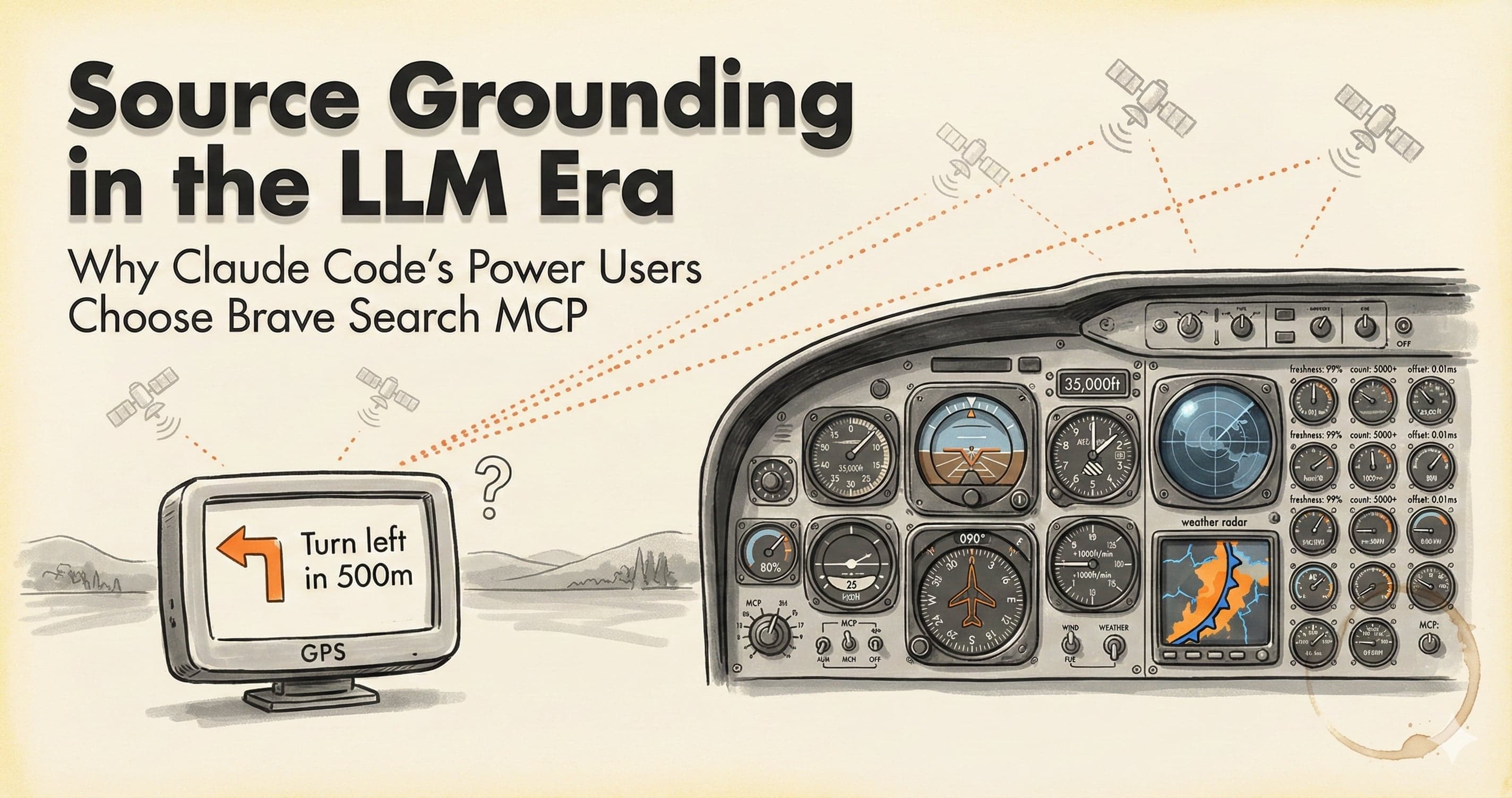
TL;DR Same engine, different controls: Claude Code's WebSearch and Brave Search MCP share the identical Brave Search backend—confirmed through BraveSearchParams discovery [TechCrunch] and 86.7% result correlation [TryProfound] The parameter gap: Bui...
Introduction Building a truly uncensored local LLM environment represents a breakthrough in information democracy. By combining Ollama's streamlined runtime with Gökdeniz Gülmez's JOSIEFIED-Qwen3:8b model—which uses both abliteration and fine-tuning...
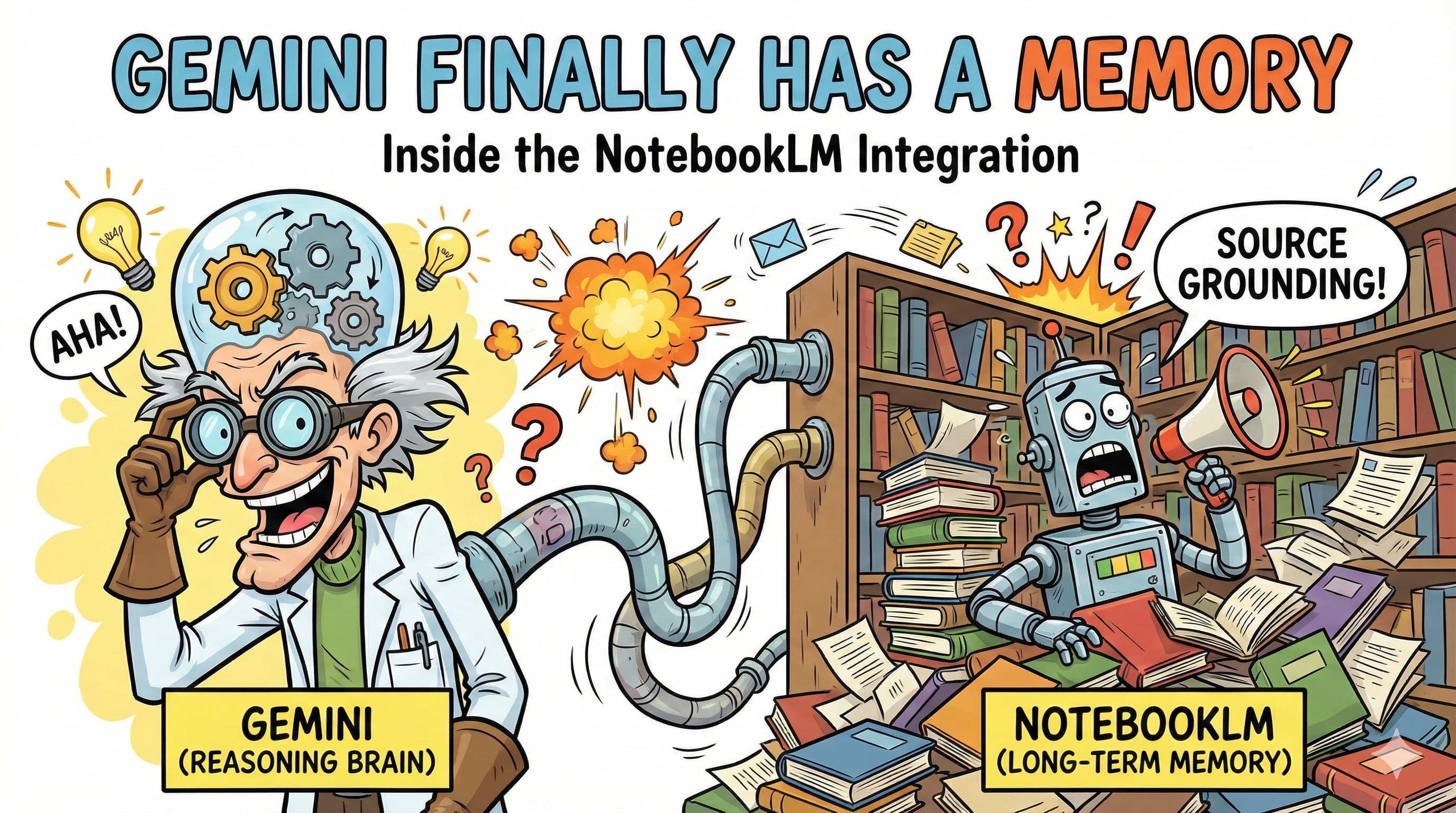
In the final week of December 2025, Google quietly redrew the map of the AI industry. On December 17th, the company began rolling out NotebookLM integration to the Gemini app. Two days later, on the 19th, NotebookLM's internal engine was officially upgraded to Gemini 3. [Link]
On the surface, it looks like a routine model swap and feature addition. But beneath that surface lies the final piece of a puzzle Google has been assembling for over two years.
One way to understand this integration is through a cognitive architecture lens. If Gemini functions like the prefrontal cortex—the brain region responsible for reasoning, planning, and creation—then NotebookLM serves as the hippocampus—the organ that stores and retrieves long-term memory. When these two meet in a single interface, AI finally acquires "memory." This analogy, proposed by tech analysts at Phandroid and others, captures the essence of what Google is building. [Link]
"🥁 NotebookLM is OFFICIALLY built on Gemini 3! Google's most intelligent model, this brings significant improvements to NotebookLM's reasoning and multimodal understanding." — @NotebookLM, December 19, 2025 [Link]
A single sentence, but its weight was anything but light. Since first appearing in May 2023 under the experimental codename "Project Tailwind," NotebookLM has been one of the AI products Google has nurtured most carefully.
The team led by nonfiction author Steven Johnson and product manager Raiza Martin has adhered to a distinctive philosophy: "an AI that answers based only on sources the user provides." This approach has cultivated a cult-like following among students and researchers.
Two days earlier, on December 17th, Google made another important announcement. When you click the [+] button in the web version of the Gemini app, a new option now appears: "NotebookLM." Users can select their notebooks and attach them as context for conversations. [Link]
"With NotebookLM in Gemini, you can now add notebooks as sources. Combine them with notes and research for more grounded responses." — Google Blog [Link]
| Evidence | Source |
| "NotebookLM has historically used the Flash variants" | 9to5Google |
| "Previously, NotebookLM was based on the Gemini 2.5 Flash model" | Android Central |
| "The NotebookLM Gemini 3 upgrade likely uses the fast Gemini 3 Flash variant" | Phandroid |
"It's almost certainly Flash. It's optimized for scanning vast amounts of documents, and since NotebookLM's outputs come directly from uploaded sources, the Thinking capability isn't essential." — u/ProbingYourProstate, r/GeminiAI [Link]
"NotebookLM has always used Flash models. That's why it didn't use Gemini 3 until now—because Gemini 3 Flash wasn't available yet." — u/REOreddit, r/GeminiAI [Link]
| Date | Announcement | Source |
| Dec 17, 2025 | Gemini app(web only) begins NotebookLM integration rollout | [Link] |
| Dec 17, 2025 | Gemini 3 Flash global launch | [Link] |
| Dec 19, 2025 | NotebookLM officially announces Gemini 3 transition | [Link] |
| Dec 19, 2025 | Data Tables feature launches | [Link] |
NotebookLM is built on RAG(Retrieval-Augmented Generation) architecture. Rather than feeding entire documents into the LLM at once, it retrieves only the "chunks" relevant to the user's question and provides them as context.
This structure allows NotebookLM to handle hundreds of sources while maintaining its strict principle: "It won't say anything that isn't in the sources."
With the transition from Gemini 2.5 Flash to Gemini 3, improvements include:
A paper published on arXiv, "NotebookLM as a Socratic physics tutor," clearly explains the core value of this RAG-based design:
"By grounding its responses in teacher-provided source documents, NotebookLM helps mitigate one of the major shortcomings of standard large language models: hallucination." — arXiv:2504.09720 [Link]
How it works:
Source Limits:
| Subscription Tier | Sources per Notebook | Number of Notebooks |
| Free | 50 | 100 |
| Google AI Pro (~$20/month) | 300 | 500 |
| Google AI Ultra (~$250/month) | 600 | 500 |
"This approach positions Gemini as the reasoning brain and NotebookLM as the long-term memory." — Phandroid [Link]
To extend the cognitive analogy introduced earlier:
Google's architecture mirrors this division:
This separation is philosophically significant. Using NotebookLM alone means 100% Source Grounding—it absolutely will not say anything not in the sources. Hallucination is blocked at the source, at the cost of creative expansion. Combine it with Gemini, however, and you get Source Grounding + Web Search + creative Reasoning. The choice between reliability and extensibility is now in the user's hands.
"By combining Gemini's conversational capabilities with NotebookLM's document grounding, Google is creating a system that can maintain context across complex, long-term projects while still providing the flexibility of general AI assistance." — Gadget Hacks [Link]
"In contrast to OpenAI's approach of 'shoving' everything into ChatGPT, these launches are not cluttering the core Gemini experience. They can sink or swim (as NotebookLM has!) on their own." — a16z [Link]
"This is incredible because now you can just ask it to create games, interactive apps, simulations using context from your notebook. Google's moat is getting wider day after day." — u/hi87 (79 upvotes)
"NotebookLM is one of the best research platforms in my opinion. You can throw hundreds of websites and docs into it and it uses RAG to sort through and display the most logical information for a user's query. I have entire textbooks on there for my job and it would be amazing to be able to call to in my Gemini chats when I need quick help with something." — u/llkj11 (69 upvotes)
"You get the reasoning horsepower Gemini plus it's web searches, combined with NotebookLM's Sources which means Gemini will have nearly unlimited memory." — u/TheLawIsSacred
"This is a total game changer! RIP ChatGPT." — u/Maddy_Cat_91 (26 upvotes)
"I found the chat inside NLM limiting. For example, if I have a notebook about some software architecture, and I want to actually implement a solution based on the principle in the notebook, I got better results by: asking NLM to create a single document and then add it to Gemini as a source." — u/somegetit [Link]
"NotebookLM needs Gemini 3 Pro Thinking. It's impossible to find connections between different clauses in legal documents. GPT-5.1 Thinking did this." — u/Honest_Blacksmith799, r/notebooklm [Link]
"It's by design. Thinking increases the possibility of hallucination. In the same vein, Gemini cannot process as many tokens as NotebookLM without serious hallucination. If you want both, extract the info you need from NotebookLM and then throw it at Gemini." — u/MegavanitasX (89 upvotes)
"One thing that makes NotebookLM stand out from other AIs is that it ONLY pulls information from the sources I provide. If I upload astronomy material only and ask about Shakespeare, it says it doesn't know. That's the strength. If you use another model, it will pull in external information." — u/FrinchFry67
The core of this debate is the reliability vs. creativity tradeoff. The reason for NotebookLM's existence is "a trustworthy AI that references only my sources." Adding Thinking mode could compromise that core value.
Google's resolution to this dilemma is elegant: role separation. Use NotebookLM internally for 100% source-grounded reliability; connect it to Gemini when you need creative expansion, web search, or cross-referencing. The choice between reliability and extensibility is now in the user's hands—a pragmatic design decision that respects both use cases.
| Scenario | Recommended Approach |
| Academic research requiring accurate citations | NotebookLM internal chat |
| Source-based creation/coding/expansion questions | Attach notebook in Gemini |
| Cross-referencing multiple notebooks | Attach multiple notebooks in Gemini |
| Combining latest web info + your documents | Notebook + web search in Gemini |
"Don't use NotebookLM for data analysis. If you ask it to average a 1000-row spreadsheet, it might calculate based on only 400 rows." — u/Suspicious-Map-7430, r/notebooklm
Behind all of this is the name Josh Woodward. He joined Google as a product management intern in 2009 and now serves as VP overseeing the Gemini app and Google Labs. [Link]
According to CNBC's profile, in mid-2022 Woodward and a small team conceived an idea for "an app that helps with research, thinking, and writing based on sources users provide directly." The project, then codenamed "Project Tailwind," emerged as "NotebookLM" in July 2023.
"Woodward helped shepherd the project through several iterations to what morphed into NotebookLM, a popular product that analyzes articles, PDFs or videos a user uploads, and provides summaries or offers insights." — CNBC [Link]
"If Google Gemini catches up to OpenAI's ChatGPT in the new year, it will probably be because a key exec responds directly to Reddit complaints." — Morning Brew [Link]
Google's strategy is clear: AI ecosystem integration. NotebookLM, Gemini, Drive, Docs, and Sheets are connecting into a single "intelligence layer."
This stands in stark contrast to competitors. OpenAI has been "shoving" everything into ChatGPT—Projects, Custom GPTs, memory features, web browsing—creating an all-in-one monolith. Anthropic's Claude takes a similar approach with its Projects feature. Google, however, let NotebookLM succeed as an independent product before connecting it to Gemini. As a16z noted, these products "can sink or swim on their own."
The result is a modular architecture where each component does what it does best: NotebookLM for source-grounded research, Gemini for reasoning and creation, Drive for storage, Sheets for data manipulation. Users aren't forced into a single interface—they choose the tool that fits their task.
Of course, this is also a lock-in strategy. Users upload hundreds of sources to NotebookLM, connect them to Gemini for work, export to Google Sheets via Data Tables. All of these workflows complete within the Google ecosystem. But unlike forced lock-in, this is value-driven lock-in—users stay because the integrated experience genuinely works better.
Looking ahead, the question is whether Google can maintain this modular elegance as AI capabilities expand. Will NotebookLM eventually fold into Gemini, or will it remain a specialized tool? For now, Google is betting on specialization—and that bet appears to be paying off.