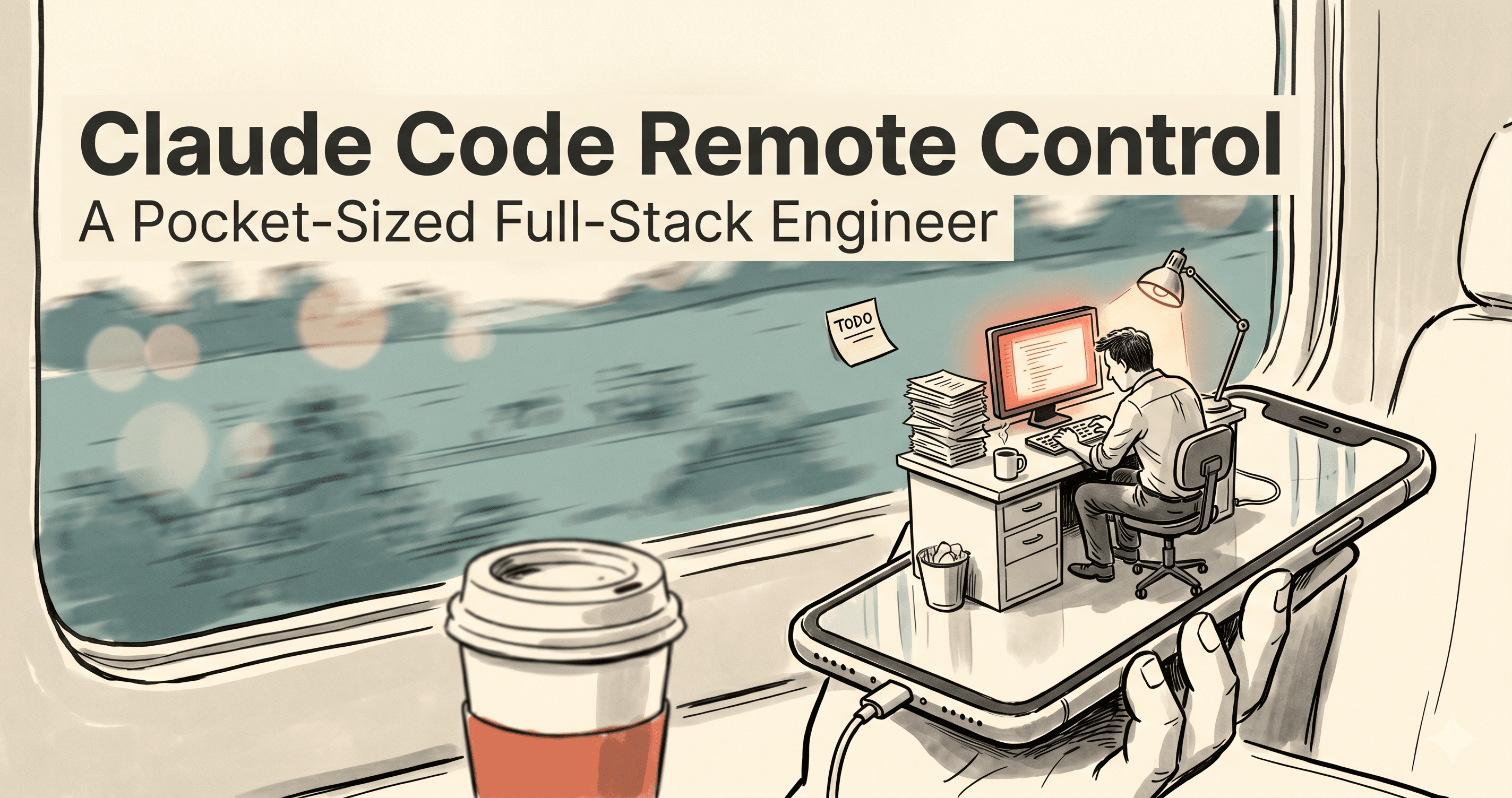
Claude Code Remote Control: A Pocket-Sized Full-Stack Engineer (Finally)
Search for a command to run...
No comments yet. Be the first to comment.
TL;DR The indexing era is ending. Once LLMs start generating most of your notes, traditional vector databases become a tax — embeddings to rebuild, egress fees to pay, dimensions to rotate. A folder
1M Context, Agent Teams, and Why Your CLAUDE.md Is Now Half the Battle
TL;DR Same engine, different controls: Claude Code's WebSearch and Brave Search MCP share the identical Brave Search backend—confirmed through BraveSearchParams discovery [TechCrunch] and 86.7% result correlation [TryProfound] The parameter gap: Bui...
Introduction Building a truly uncensored local LLM environment represents a breakthrough in information democracy. By combining Ollama's streamlined runtime with Gökdeniz Gülmez's JOSIEFIED-Qwen3:8b model—which uses both abliteration and fine-tuning...

remote-control and finally let the laptop talk to your phone. The announcement landed exactly ten days after OpenClaw's creator joined OpenAI to build the same idea from the other side. Coincidence is doing a lot of work in that calendar.tmux over mosh over ngrok is officially retired./clear is the most-quoted offender, for a structural reason worth understanding), and the v2.1.119 / v2.1.120 regression bomb on April 24 turned "don't npm install -g @latest" into a community proverb. Pin v2.1.117. Watch status.claude.com. Be the second mouse.For almost a year, Claude Code had a strange, almost theological limitation for a tool that branded itself "agentic": the agent only existed where the desk was. It could plan a sprint, refactor a monolith, write tests, fight webpack, and apologize for it later — but only if you were physically present in the chapel where the laptop sat. Step away to grab coffee, and your seven-figure-trained AI co-worker stared at a blinking cursor with the patient devotion of a Labrador waiting for someone to come back through the door.
Naturally, the community refused to accept this. Developers wrapped Claude Code in tmux sessions exposed over mosh, glued it to Telegram bots, tunneled it through Tailscale, hot-wired it to ngrok, and built half a dozen clever-but-fragile bridges to drive their terminal from the express train home. Each hack worked until it didn't. None of them were officially supported. Every Anthropic version bump was a coin flip on whether your weekend infrastructure still booted on Monday — a state of affairs the more honest hackers described, on Reddit, as "production-grade duct tape."
Then, on February 24, 2026, Anthropic ended the workaround economy in one tweet from PM Noah Zweben: "Try it with /remote-control. Start local sessions from the terminal, then continue them from your phone." [Link] The CLI suddenly grew a mobile app — officially, with auth, with audit logs, with a docs page that no longer carried the yellow "Research Preview" banner that quietly disappeared sometime in April. [Link]
Hacker News received it with the warmth that only Hacker News can muster:
"This is an extremely clunky and buggy prerelease, so don't try to hot fix prod from the toilet without a different mobile frontend." — top comment, HN item 47148454
Here is the part Anthropic's blog will not say out loud. Claude Code is sold as a flat-rate subscription — \(20/mo on Pro, \)200/mo on Max — and a flat-rate plan loves a customer who stops working when they leave the desk. Every minute the laptop is closed is a minute the model is not burning compute. Letting users summon sessions from a beach in Bali is, in a very literal sense, a margin event. The infrastructure to do it had existed inside the company for months. The decision to ship it had not.
So why ship remote-control now? The most plausible answer points to Vienna, to Peter Steinberger — the PSPDFKit founder turned solo agent-hacker. Late in 2025 he shipped an open-source, model-agnostic desktop driver named Clawdbot, briefly rebranded it to Moltbot under legal pressure, and on January 27, 2026 received an Anthropic cease-and-desist over the trademark — at which point it became, with audible glee, OpenClaw. [Fortune] [VentureBeat] The product was a polite middle finger to Claude Code's deskbound life: it ran on a phone, called any model, and did the one thing the official CLI stubbornly refused to — let the user drive from anywhere. [MindStudio]
Then the calendar moved into a configuration that is hard to read as accidental. On February 14, 2026, Steinberger announced he was joining OpenAI to lead its personal AI agent efforts. Ten days later, Anthropic shipped remote-control. Read forward, the dates look like a polite handshake. Read backward, they look like the moment the incumbent realized the challenger had switched teams to the only competitor with deeper pockets.
The chess move was familiar. Claude Code was, after all, the first general-purpose agent to actually hit the mainstream — the original incumbent. And incumbents have a famous disease: when a hungrier challenger redefines the category, they ship the obvious feature they had on the shelf for months. Google spent 2022 sitting on LaMDA while OpenAI shipped ChatGPT and rewrote the map. Anthropic clearly read that book and decided not to play the same character. remote-control was, in effect, a tax cut Anthropic levied on itself to keep OpenClaw from owning a category Anthropic had created.
| Era | Incumbent | Challenger | Incumbent's Reflex |
|---|---|---|---|
| 2022–23 LLM chat | Google LaMDA | OpenAI ChatGPT | Too late, lost the narrative |
| 2025–26 agentic coding | Claude Code (terminal-only) | OpenClaw (anywhere, any model) | Anthropic ships remote-control in 90 days |
remote-control was the opening shot. By April 10, Anthropic had also temporarily banned Steinberger's account from Claude API access — restored shortly after the resulting TechCrunch story — which is the universal corporate body language for "we'd like our oxygen back, thank you." [TechCrunch]Strip away the marketing and remote-control is a small, well-behaved server that runs alongside your normal Claude Code process. It opens an outbound HTTPS rendezvous to claude.ai — no inbound port, no firewall surgery, no router config — and the Claude mobile app (or the web client at claude.ai/code) picks up the session as if you'd typed it locally. [Link]
The architectural metaphor is worth holding onto. The old hacks (mosh, ngrok, Tailscale) all worked by drilling a hole in your house: you opened a door so the outside could come in. remote-control inverts the topology — your laptop walks down to the post office every few seconds and asks if any mail arrived. No door is opened. No port is exposed. From a corporate-VPN-behind-CGNAT-on-hotel-Wi-Fi standpoint, this is the difference between "please file a ticket with IT" and "it just works."
That second phrase is not marketing. It is a Reddit comment with 245 upvotes:
"I'm literally sitting in my car on 5G right now talking to the same Claude that has full context on my entire workflow. No extra apps. No Telegram. No port forwarding or Tailscale. It just works over outbound HTTPS through Anthropic's servers." — u/JohnnyLegion, r/ClaudeCode
The headline feature, added in v2.1.74, is --spawn: you don't pre-create sessions on the laptop, you summon them from the phone on demand. One server, up to 32 flexible slots. [Link] The same release made --spawn=worktree first-class, which means each phone-spawned session lands in its own git worktree — no more "two agents fighting over the same branch" disasters.
And because Anthropic had a year to think about the failure modes, the supporting cast is unusually polished:
| Capability | Version | What It Means |
|---|---|---|
| Mobile session spawn | v2.1.74 | Phone creates new sessions, not just resumes |
| Wake-from-sleep reconnect | v2.1.71 | Laptop lid open → reconnect in seconds (was up to 10 minutes) |
/loop integration |
v2.1.113 | Phone-triggered scheduled loops run inside the RC session |
@-file autocomplete on mobile |
v2.1.113 | Tab-complete file paths from your thumb |
| Push notifications | v2.1.118+ | Agent pings your phone when it needs a decision [Link] |
/color sync |
v2.1.118 | Session accent color matches across desktop and phone |
# 1. Keep the user systemd session alive after logout/SSH disconnect.
#    Without this, tmux dies the moment your last shell exits — taking
#    every Claude Code session inside it down with it.
sudo loginctl enable-linger $USER

# 2. Unset telemetry-blocker env vars in the current shell.
#    The eligibility check for Remote Control IS a non-essential telemetry call.
#    Block telemetry, lose your eligibility — a fail-closed paradox: the
#    privacy-conscious developer is the one most likely to see
#    "Remote Control is not yet enabled for your account."
unset CLAUDE_CODE_DISABLE_NONESSENTIAL_TRAFFIC DISABLE_TELEMETRY DO_NOT_TRACK

# 3. Launch the RC server inside a detached tmux session.
#    -d runs detached so the next shell prompt comes right back.
#    --capacity 32 sets the parallel-session ceiling.
#    --spawn=worktree drops each new session into its own git worktree.
#    --sandbox keeps each spawned session in its own filesystem cage —
#    Anthropic refused to support --dangerously-skip-permissions for RC
#    (issue #31908), so --sandbox is the only "approve once, sleep at night"
#    option for a phone-driven agent.
tmux new -d -s rc "claude remote-control --capacity 32 --spawn=worktree --sandbox"
That's the whole thing. Open the Claude app, sign into the same claude.ai account, and your laptop's hostname appears as a remote target. Tap "new session", pick a directory, and you're typing prompts at a real Claude Code instance — except the keyboard is your thumb.
I have been running this exact recipe for over a week, sustaining 32 parallel sessions without a single manual intervention. The on-demand spawn model is the part that quietly changes how you work: you stop pre-allocating sessions ("one for the API repo, one for the frontend, one for docs") and start spawning them like browser tabs. A morning that used to mean "launch four terminals and arrange them on three monitors" becomes "tap the app, tap a folder, type the prompt." Sessions stop being infrastructure. They become a UI element.
The three-line recipe has one crack, and it shows up the first time Windows Update reboots your laptop at 3 a.m. The next morning your phone taps into thin air — the WSL2 instance is cold, tmux never started, the RC server doesn't exist. The thirty seconds between "sit down at the desk" and "unlock the screen" become a small daily fissure in the 24/7 promise. That fissure is the difference between an agent and a tool you have to babysit, and closing it deserves its own chapter — because the patch is a one-time ritual you perform once and forget about forever.
Mac users sealed this hole back in March with a single launchd plist that JohnnyLegion posted in r/ClaudeCode [245 upvotes]. One file, one launchctl load, done. The Windows + WSL2 equivalent took me longer to land, but it is the same idea wearing different clothes: get the host OS to launch the recipe at boot, before the user logs in, in a context that has no terminal attached. The patch comes in three pieces — a script that survives being called without a human, a sudo landmine defused with one line, and Windows Task Scheduler with exactly four checkboxes ticked correctly.
First, the script that survives being called without a human. Wrap the three commands into a shell file with two guards that let it run when nobody's watching:
# ~/your-repo/start-claude-code-remote-control.sh
#!/usr/bin/env bash
set -euo pipefail
SESSION="${1:-rc}"
sudo loginctl enable-linger "$USER"
unset CLAUDE_CODE_DISABLE_NONESSENTIAL_TRAFFIC DISABLE_TELEMETRY DO_NOT_TRACK
if ! tmux has-session -t "$SESSION" 2>/dev/null; then
  tmux new -d -s "$SESSION" "claude remote-control --capacity 32 --spawn=worktree --sandbox"
fi
if [ -t 1 ]; then
  tmux attach -r -t "$SESSION"
fi
The two new guards are load-bearing. tmux has-session makes the script idempotent — a boot trigger can call it ten times in a row and you still end up with exactly one RC server, not ten zombies fighting for the same socket. [ -t 1 ] is the TTY guard: when you run the script from your shell, stdout is a terminal and tmux attach works as expected; when Windows fires it from the lock screen, stdout is a pipe, and tmux attach would throw "not a terminal" — and with set -e enabled, that single error kills the script before RC ever starts. One bracket-test saves the whole chain.
Second, the sudo landmine. sudo loginctl enable-linger works fine when you type it, because you are there to answer the password prompt. A boot trigger has no keyboard. The script would hang forever behind the lock screen, an invisible cursor blinking at no one. The fix is a single line in visudo, scoped to exactly that one command:
# sudo visudo, then add:
<your-user> ALL=(ALL) NOPASSWD: /usr/bin/loginctl enable-linger <your-user>
That is not blanket NOPASSWD: ALL, which is the security posture of a teenager who's just discovered chmod 777. The path is pinned, the argument is pinned, the username is pinned. The attack surface grows by exactly one verb — "this user may, without a password, mark this user as linger-eligible" — and nothing else. Every other sudo call in your shell still asks for the password, the way it should.
Third, Task Scheduler, because Windows leaves you no other options. Startup folder scripts fire after logon, which is exactly when the fissure has already opened. Services can't reach into WSL2 cleanly. Task Scheduler, with the right four checkboxes, can — and it is the only mechanism on Windows 11 that can run something before a user logs on. Open it, click Create Task... (not the Basic wizard — you need the full options dialog), and walk through the four tabs in order:
AutoStart Claude Code Remote Control. Tick Run whether user is logged on or not. Leave Do not store password unchecked (Windows needs to remember a credential to run as your user without a session). Tick Run with highest privileges.wsl.exe. Add arguments: -d Ubuntu -e bash -ic "cd /home/<your-user>/your-repo && ./start-claude-code-remote-control.sh". The -i in bash -ic is non-negotiable: a non-interactive shell never sources ~/.bashrc, so nvm never loads, and claude is not on PATH. The error you'd see — "claude: command not found" — would be invisible because nobody is watching the lock screen.Save the task, type your Windows account password when prompted, and the next reboot — including the next forced Windows Update reboot at 3 a.m. — quietly stands the RC server back up before the lock screen even renders.
The verification ritual is the satisfying part. Reboot the machine. Don't log in. Walk to another room. Refresh the environment list in the Claude app on your phone, and watch the "remote-control: rc" target light up — alive, idle, waiting — on a laptop that hasn't even seen your face yet. You can spawn the day's first session on the subway, before the office coffee has finished brewing. This is the structural equivalent of JohnnyLegion's launchd plist — same abstraction, two more boxes to tick — and it deserves the same mental drawer as the three-line recipe: a one-time setup you stop thinking about, except to recommend.
/clear is the most-cited mobile bug, and the reason it fails is more interesting than the failure itself. Slash commands like /clear, /compact, /context, /help need to be intercepted by the local Claude Code runtime before they reach the model — they manipulate session state, not prompt content. The mobile path forgets to intercept. So when you tap /clear from your thumb, the literal text /clear sails past the interceptor and lands in the model as a prompt, where Claude politely tries to interpret it as an instruction instead of executing it. The session does not get cleared; it gets confused. [GitHub #40388] [GitHub #30674]
The community fix is the kind of small, perfect hack that this category seems to manufacture every few weeks. argognat's claude-mux, released in April 2026, teaches each Claude session that it lives inside a tmux pane and can therefore call tmux send-keys on itself. Slash commands fail to intercept on the way in, so the model intercepts them on the way back: ask "please switch this session to plan mode" from your phone, and Claude obediently types /plan into its own terminal. The interceptor is broken? Make the model the interceptor. [claude-mux]
The bigger sharp edge is the release cadence. On April 23, 2026, Anthropic published an unusual engineering postmortem admitting three system-prompt regressions had degraded model quality and reset every subscriber's usage cap. [Link] The next day, v2.1.119 and v2.1.120 shipped with eight simultaneous regressions — --resume crashes, silent 1M-context routing on Opus, WSL2 /mcp freezes, macOS 26.4 worktree hangs — and v2.1.120 was auto-rolled back to v2.1.119 by April 25. [Link]
The community's response — a 315-upvote r/ClaudeCode thread defiantly titled "Successfully updated from 2.1.120 to version 2.1.119" — hardened into a single proverb that now governs RC operations: do not chase @latest. Pin v2.1.117 in npm, bookmark status.claude.com, and let the rest of the internet be the canary in your coal mine.
Simon Willison, who reviewed the original release with the dry verdict "It's a little bit janky right now" [simonwillison.net], surveyed the April wreckage with characteristic understatement: the cluster of issues was "concerning" because "there have been quality issues across the board lately, but they've been hard to definitively pin down." [Apr 24, 2026] That last clause is the real story — the bugs aren't loud crashes you can grep for; they're vibes-degraded outputs that make you wonder whether you got worse at prompting. Remote Control's job is to put Claude Code in your pocket. Anthropic's job, two months in, is to make sure it's still the same Claude Code when you tap it.
| Axis | Mechanism | What It Buys You |
|---|---|---|
| Spatial (parallel) | remote-control --capacity 32 |
Drive 32 sessions from a phone |
| Temporal (recurring) | /loop × cron, integrated in v2.1.113 |
Run something every N minutes, unattended |
| Cloud-resident | Claude Cowork GA on April 9, 2026 [Link] | Sessions that don't need your laptop on at all |
| Cloud-autonomous | /schedule × Routines, demoed by Noah Zweben on X, April 23, 2026 |
Scheduled jobs that run on Anthropic's infra even with your computer powered off |
remote-control covers the spatial axis. Cowork covers the cloud axis. /loop covers time. Routines covers the part of time when even your laptop is asleep. Together they answer the awkward question that haunted the OpenClaw comparison: "why would I run an agent on a laptop that has to stay open?" The honest answer in February was "because Anthropic hadn't shipped the alternative yet." By late April, that excuse is gone, replaced by a four-axis chassis the rest of the field is now scrambling to copy.
Birgitta Böckeler, writing for Thoughtworks in April, gave this whole layer a name: "harness engineering." The model is the horse; RC, Routines, Cowork, Cursor Agents, Codex App Server, and Windsurf's Agent Command Center are the harnesses. Without harness, the horse goes nowhere. The harness, not the horse, is now where the differentiation lives. RC is the pair of light reins between your hand and the horse's mouth. Routines is the long carriage road that returns without a driver. Same horse. Different tack.
Anthropic's strategy with remote-control is, in retrospect, a textbook incumbent counterpunch: identify the one thing the challenger does that you don't, ship it in 90 days, and deny OpenClaw the oxygen of being "the only way to drive an agent from your phone." The fact that doing so quietly multiplies subscription utilization — and therefore lights flat-rate compute on fire on Pro and Max plans — is the strongest possible signal that the company priced category leadership higher than next quarter's gross margin. With Anthropic fielding investor offers at an \(800B primary valuation and a \)1T secondary-market implied print [Bloomberg], they can afford to set a few million dollars of compute on fire to keep the throne warm.
This is what makes the timing so legible. Claude Code was the original mainstream agent. The dilemma it now navigates rhymes uncomfortably with Google's 2022 — first to the technology, slow to the obvious productization, suddenly chased by an upstart that took the obvious move and shipped it without permission. Anthropic read that history and chose to play OpenAI's 2022 role against itself, shipping the cannibalizing feature before someone else made it irrelevant. The fact that the someone else, in this case, had just been hired by the actual OpenAI is the kind of plot twist that makes the whole sequence hard to file under "coincidence."
The result is a CLI that has finally grown out of its chair. Three lines of bash on a WSL2 machine, a phone in a pocket, and you have something that genuinely deserves the "full-stack engineer in your pocket" label that every AI product page has been printing as a lie since 2023. Whether you're walking the dog or stuck in a meeting that should have been an email, Claude Code is now waiting for prompts in a place it has never been before — wherever you are.
Of course, the road from "works" to "works boringly" is still being paved. /clear is broken on mobile (until you teach the model to type /clear to itself), silent-hang issue #51267 has replaced the old eight-hour death mystery with a quieter one, and the v2.1.119/120 weekend reminded everyone that Anthropic's latest tag is a release-candidate channel wearing a stable channel's name tag. Pin the build, watch the status page, and treat the feature like an excellent intern — capable of shipping production code, but not on a Friday afternoon and not without supervision.
Looking ahead, the more interesting question is not whether remote-control matures — it will — but whether the category settles into something stable or keeps mutating under it. OpenAI Codex added desktop computer-use and remote SSH devboxes on April 16. SpaceX announced, on April 21, a $60B option to acquire Cursor [Reuters] — a sentence that, written down, still doesn't quite parse. The pocket-sized full-stack engineer has stopped being a vision and started being a checkbox three companies are racing to fill in with rocketship money. The only safe prediction: the version of remote-control you set up tonight will look quaint by August. Don't worry — that's the good outcome. The other one is that nothing changes, and we already know how that movie ends in a Mountain View boardroom in 2022.
So drive your agent from the train, the car, the dog park, the line at the coffee shop. Just remember Hacker News's opening benediction, which has aged into the only operating manual you actually need:
"don't try to hot fix prod from the toilet."